
Bacteriostatic Water vs Reconstitution Solution for Research Peptides
A technical breakdown of solvent requirements, benzyl alcohol preservation standards, pH buffering, and solubility guidelines for reconstituted peptide sequences.

Research Takeaway: Reconstitution is the most critical step in preserving the biological activity of lyophilized peptides. The presence of 0.9% Benzyl Alcohol determines whether a solvent is suited for multi-draw multi-day laboratory protocols or restricted to immediate single-use assays.
Executive Overview: Peptide Solvent Chemistry
Lyophilization (freeze-drying) removes water from synthesized peptide sequences to create a stable, solid matrix. To utilize these compounds in laboratory assays, researchers must solubilize the powder using a compatible liquid vehicle.
The two terms most commonly encountered in laboratory supply catalogs are Bacteriostatic Water and Reconstitution Solution. While often used interchangeably, critical differences in preservative formulation, osmolarity, and pH buffering dictate their proper research application.
Benzyl Alcohol: The Core Preservative Mechanism
The primary distinction between generic sterile water and bacteriostatic water is the addition of 0.9% (w/v) Benzyl Alcohol (C7H8O).
Antimicrobial Mechanism
Benzyl alcohol acts as a bacteriostatic preservative by:
- Membrane Disruption: Permeabilizing the lipid bilayer of gram-positive and gram-negative bacteria.
- Inhibition of Cellular Respiration: Halting bacterial replication inside the vial without precipitating the peptide solute.
- Multi-Entry Protection: Protecting the sterile vial environment when rubber stoppers are punctured repeatedly over a 28-day research study.
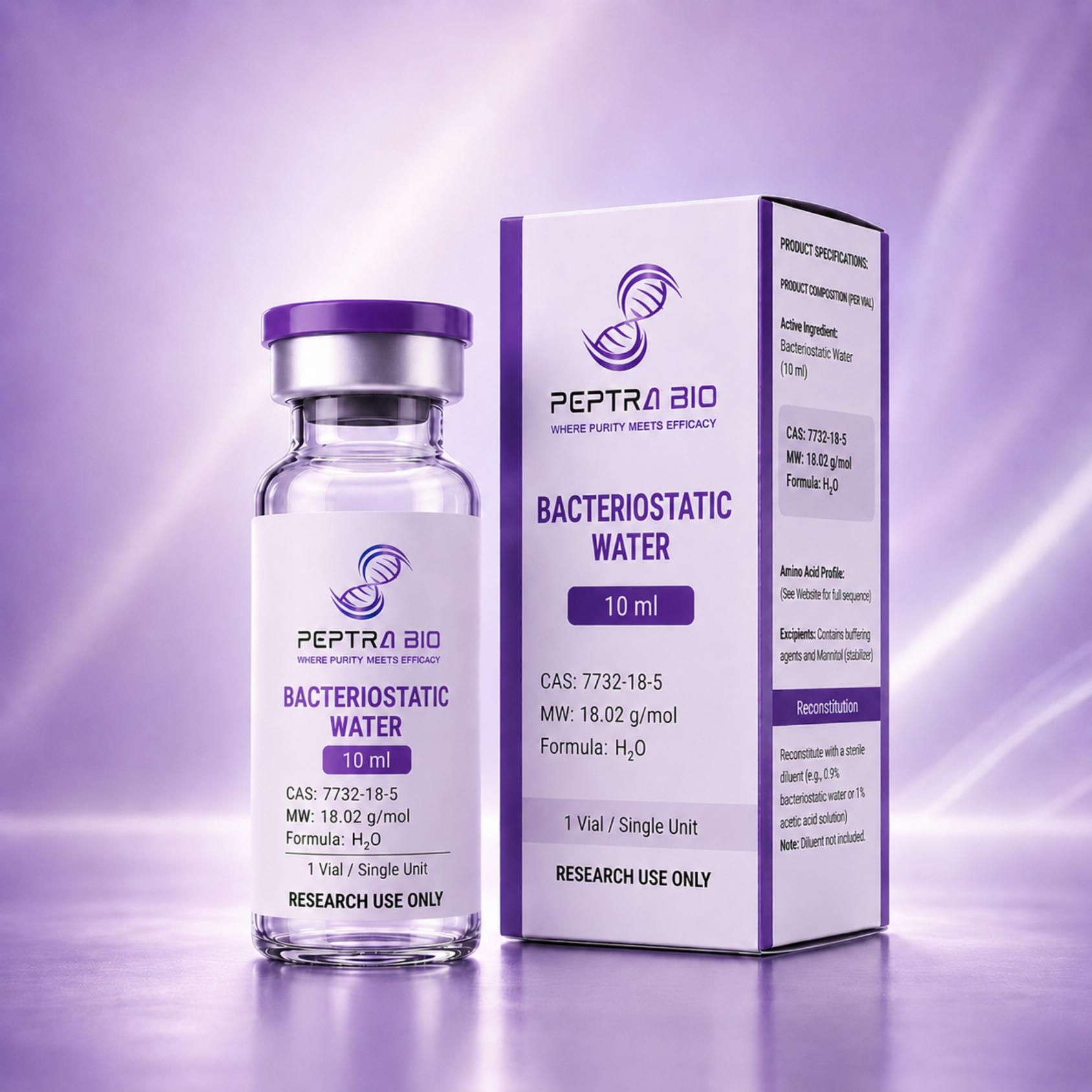
Comparative Solvent Selection Matrix
| Solvent Formulation | Preservative Content | Multi-Draw Compatibility | Shelf Life After Puncture | Ideal Research Applications |
|---|---|---|---|---|
| Bacteriostatic Water (0.9% Benzyl Alcohol) | 0.9% Benzyl Alcohol | Yes (up to 28 days) | 28 days at 2°C–8°C | Multi-day in vitro assays, serial dilution curves |
| Plain Sterile Water (USP) | None | No (Single use) | Immediate (< 4 hours) | Sensitive cell culture assays where alcohol inhibits cell growth |
| Bacteriostatic 0.9% NaCl | 0.9% Benzyl Alcohol + 0.9% NaCl | Yes (up to 28 days) | 28 days at 2°C–8°C | Hydrophobic peptides requiring isotonic balance |
| Acetic Acid (0.1%–1.0%) Solution | None (Acidic buffer) | Single use | Immediate | Basic / hydrophobic peptides (e.g., GHRPs, Melanotan) |
Step-by-Step Laboratory Reconstitution Protocol

To avoid peptide denaturation and mechanical shearing during reconstitution, laboratory technicians should adhere to the following protocol:
Step 1: Temperature Equilibrium
Allow the lyophilized peptide vial and the bacteriostatic water vial to equilibrate to room temperature (20°C–25°C) for 15 minutes before mixing.
Step 2: Aseptic Preparation
Swab the septum of both vials with 70% isopropyl alcohol and allow them to air-dry completely.
Step 3: Controlled Fluid Transfer
- Draw the calculated solvent volume using a fine sterile syringe.
- Incline the peptide vial at a 45-degree angle.
- Direct the needle stream against the glass wall of the vial, allowing the solvent to gently cascade over the lyophilized cake. Never spray directly onto the peptide powder.
Step 4: Gentle Dissolution
Allow the cake to absorb the liquid passively. Gently swirl the vial in a circular motion. Do not shake vigorously, as turbulent agitation can shear fragile tertiary peptide bonds and form irreversible aggregates.
Handling Hydrophobic & Basic Peptide Sequences
Certain hydrophobic peptide fragments (such as AOD-9604, IGF-1 LR3, or certain GHRH analogs) may exhibit turbidity or incomplete dissolution in pure bacteriostatic water:
- Acidic Pre-Solubilization: Adding a small volume (10–50 µL) of sterile 0.1M Acetic Acid or Dilute Hydrochloric Acid protonates basic residues, promoting full solubility before diluting to volume with bacteriostatic water.
- Basic Buffer System: For acidic peptides, adding 0.1M ammonium bicarbonate facilitates rapid clarity.
Frequently Asked Questions (FAQ)
What is the difference between sterile water and bacteriostatic water?
Sterile water contains no preservatives and must be used immediately upon opening to prevent microbial growth. Bacteriostatic water contains 0.9% benzyl alcohol, which inhibits bacterial proliferation and allows multi-entry use over a 28-day period.
Can benzyl alcohol damage sensitive peptide structures?
In the vast majority of synthetic peptides (e.g., BPC-157, TB-500, CJC-1295, Ipamorelin), 0.9% benzyl alcohol does not disrupt covalent or hydrogen bonding. However, in sensitive in vitro mammalian cell cultures, benzyl alcohol may exhibit cytotoxic artifacts and sterile water or saline is preferred.
How long does a reconstituted peptide vial remain stable?
When reconstituted with bacteriostatic water and stored at 2°C–8°C, most peptide solutions maintain >95% purity for 21 to 30 days. Protect vials from light exposure.
Why is shaking a peptide vial discouraged?
Peptides consist of delicate folding chains. High mechanical shear stress from vigorous shaking can break hydrogen bonds, causing peptide denaturation, aggregation, and loss of biological affinity.
What should I do if the reconstituted solution appears cloudy?
Cloudiness indicates incomplete solubilization or aggregate formation. Verify the isoelectric point (pI) of the compound. Adding a sterile drop of 0.1M acetic acid can often solubilize hydrophobic aggregates.
Research Use Only Disclaimer
This handling guide is intended solely for laboratory researchers and chemical handling technicians. Peptra Bio products are intended strictly for laboratory in vitro experimentation.
Key References
- Manning MC, et al. Stability of protein and peptide pharmaceuticals. Pharm Res. 1989;6(11):903-918.
- Powell MF, et al. Peptide stability in aqueous solutions: Chemical degradation pathways. J Pharm Sci. 1993;82(11):1141-1148.
- Cleland JL, et al. The development of stable protein formulations: A close look at freeze-drying and stabilization. Crit Rev Ther Drug Carrier Syst. 1993;10(4):307-377.
