
BPC-157 vs TB-500: A Comprehensive Research Comparison
Compare the molecular structures, distinct mechanisms of action, and complementary pathways of pentadecapeptide BPC-157 and Thymosin Beta-4 analogue TB-500 in laboratory research.

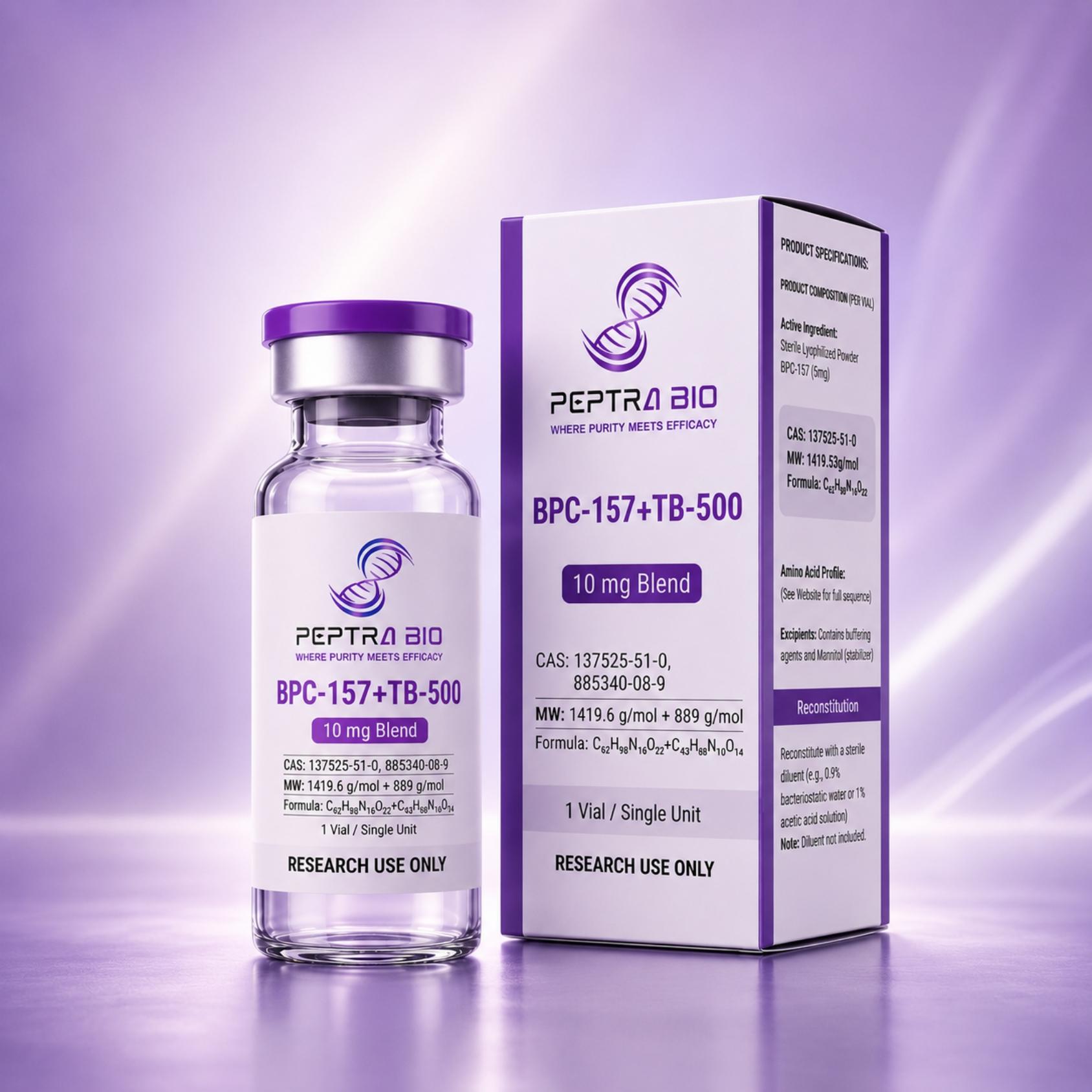
Research Takeaway: BPC-157 and TB-500 represent two of the most widely investigated synthetic peptides in preclinical regenerative biology. While BPC-157 operates primarily via nitric oxide (NO) modulation, VEGFR2 activation, and growth factor upregulation, TB-500 functions through actin sequestering and direct cellular motility to accelerate tissue repair.
Executive Overview: Comparative Regenerative Biochemistry
In preclinical wound healing and extracellular matrix (ECM) investigation, two distinct peptide sequences dominate contemporary literature: BPC-157 (Body Protection Compound 157) and TB-500 (a synthetic derivative of Thymosin Beta-4).
Although both compounds are studied for their restorative and cytoprotective properties in animal models, they function through fundamentally distinct biochemical pathways. Understanding these differences is critical for designing valid in vitro assays and animal models of musculoskeletal repair.
Molecular Structures & Biological Origins
1. BPC-157 (Pentadecapeptide)
- Amino Acid Sequence: Gly-Glu-Pro-Pro-Pro-Gly-Lys-Pro-Ala-Asp-Asp-Ala-Gly-Leu-Val
- Molecular Mass: 1419.5 g/mol
- Source & Design: A 15-amino acid sequence derived from human gastric juice cytoprotective protein. It demonstrates exceptional intrinsic stability in harsh enzymatic and acidic environments.
2. TB-500 (Thymosin Beta-4 Active Fragment)
- Amino Acid Sequence: Ac-Leu-Lys-Lys-Thr-Glu-Thr-Gln (representing the key actin-binding motif LKKTETQ of the native 43-amino acid Thymosin β4).
- Molecular Mass: 888.0 g/mol (synthetic hexapeptide fragment) / 4963.5 g/mol (full-length Tβ4)
- Source & Design: The critical active actin-sequestering domain of endogenous Thymosin Beta-4, synthesized with low molecular weight to facilitate cellular penetration and tissue diffusion.
Primary Mechanisms of Action
BPC-157: Angiogenesis & Cytoprotective Signaling
In laboratory models, BPC-157 exerts its effects primarily through the vascular endothelial growth factor (VEGF) pathway, early growth response protein-1 (Egr-1), and modulation of the nitric oxide synthase (eNOS/iNOS) balance.
- VEGFR2 Upregulation: Accelerates the formation of new capillary networks at injury sites (angiogenesis).
- Collagen Type I & III Synthesis: Stimulates tendon fibroblasts to produce structured extracellular matrix fibers.
- Gastrointestinal Protection: Upregulates focal adhesion kinase (FAK) and paxillin phosphorylation in mucosal repair assays.
TB-500: G-Actin Sequestration & Cell Motility
TB-500's primary biochemical role is the regulation of free actin monomers (G-actin) within the cytoskeleton.
- Actin Polymerization: Inhibits premature actin polymerization, maintaining a reservoir of monomers that mobile cells need to migrate toward wounded tissue.
- Matrix Metalloproteinase (MMP) Modulation: Downregulates excessive collagen crosslinking, which reduces fibrotic scar formation.
- Endothelial Cell Spreading: Promotes lamellipodia formation, facilitating rapid epithelialization in cutaneous wound models.
Side-by-Side Research Comparison Matrix
| Biochemical Parameter | BPC-157 | TB-500 (Thymosin β4 Fragment) |
|---|---|---|
| Peptide Length | 15 Amino Acids | 7 Amino Acids (active sequence) |
| Primary Target Pathway | VEGFR2 / eNOS / Egr-1 Axis | G-Actin Polymerization / MMP-2 |
| Predominant Tissue Focus | Tendons, Ligaments, Gut Mucosa, Bone | Skeletal Muscle, Cardiac Tissue, Dermis |
| Fibrosis Modulation | Moderate collagen realignment | High anti-fibrotic & scar-reducing activity |
| In Vitro Gastric Stability | High (acid/protease resistant) | Moderate (susceptible to rapid degradation) |
| Angiogenesis Mechanism | Endothelial proliferation & NO balance | Endothelial migration & tubule formation |
Preclinical Research Models & Laboratory Findings

Tendon and Ligament Defect Studies
- Achilles Tendon Transection Models: Rodent assays administering BPC-157 demonstrated accelerated restoration of biomechanical load failure tolerances and organized parallel collagen bundling within 14 days.
- Muscle Contusion & Laceration Assays: In murine laceration models, TB-500 administration showed significant reduction in inflammatory cell infiltration and lower hydroxyproline content (indicating decreased scar formation) paired with faster myofiber regeneration.
Synergistic Dual-Peptide Paradigms
Contemporary in vitro research increasingly investigates co-administration models:
- Initiation Phase (TB-500): Promotes rapid stem cell and fibroblast migration to the defect site while preventing rigid scar tissue formation.
- Proliferation & Consolidation Phase (BPC-157): Accelerates localized micro-vessel formation to deliver nutrients and stimulates dense, high-tensile collagen deposition.
Laboratory Handling & Storage Standards
- Reconstitution Solvent: High-purity Bacteriostatic Water (0.9% Benzyl Alcohol) or sterile 0.9% sodium chloride solution.
- Lyophilized Storage: Store dry powder at -20°C to ensure 24+ months of peptide stability. Protect from direct ultraviolet light.
- Reconstituted Stability: Maintain solution between 2°C – 8°C. Avoid repeated freeze-thaw cycles which degrade secondary peptide conformations.
Frequently Asked Questions (FAQ)
What is the primary biochemical difference between BPC-157 and TB-500?
BPC-157 is a 15-amino acid peptide derived from gastric juice that stimulates angiogenesis and collagen synthesis via VEGFR2 pathways. TB-500 is a 7-amino acid sequence derived from Thymosin Beta-4 that sequesters G-actin to drive cellular migration and reduce fibrotic scarring.
Can BPC-157 and TB-500 be studied together in laboratory assays?
Yes. Many preclinical research studies investigate both peptides simultaneously because their mechanisms are complementary. TB-500 facilitates rapid cellular recruitment, while BPC-157 provides microvascular supply and structural collagen organization.
How should lyophilized BPC-157 and TB-500 vials be stored?
Lyophilized vials should be stored desiccated at -20°C. Following reconstitution with bacteriostatic water, vials should be refrigerated at 2°C to 8°C and utilized within standard laboratory testing timeframes.
What purity standards are required for research-grade BPC-157 and TB-500?
Preclinical experimental protocols require peptides with ≥98% purity verified via High-Performance Liquid Chromatography (HPLC) and Mass Spectrometry (MS) to prevent off-target peptide artifacts.
Are BPC-157 and TB-500 approved for human clinical use?
No. Both compounds are strictly designated for laboratory in vitro and in vivo animal research. They are not approved by the FDA, EMA, or MHRA for human diagnostic or therapeutic applications.
Research Use Only Disclaimer
This article is prepared exclusively for scientific education and laboratory research reference. Peptra Bio supplies synthetic peptides strictly for laboratory in vitro and in vivo scientific experimentation. These products are not for human consumption, medical diagnosis, or clinical therapy.
Key References
- Seiwerth S, et al. BPC 157 and standard angiogenic growth factors. Curr Pharm Des. 2014;20(7):1126-1134.
- Chang CH, et al. The promoting effect of pentadecapeptide BPC 157 on tendon healing involves tendon outgrowth, cell survival, and angiogenesis. J Appl Physiol. 2011;110(3):774-780.
- Malinda KM, et al. Thymosin beta4 accelerates wound healing. J Invest Dermatol. 1999;113(3):364-368.
- Philp D, et al. Thymosin beta4 promotes angiogenesis, wound healing, and hair follicle development. Mech Ageing Dev. 2004;125(2):115-123.
- Vukojevic J, et al. BPC 157 and its role in healing of muscle, tendon and ligament injuries. Curr Pharm Des. 2020;26(29):3295-3304.
RELATED RESEARCH GUIDES
View All Articles →
Retatrutide vs Tirzepatide vs Semaglutide: Incretin Mimetic Comparison
A comparative biochemical analysis of mono-agonist (Semaglutide), dual-agonist (Tirzepatide), and triple-agonist (Retatrutide) peptide receptor interactions.
Tesamorelin vs Ipamorelin: GHRH vs GHRP Receptor Pathway Analysis
Compare the receptor kinetics, lipolytic specificity, and pituitary signaling of the stabilized GHRH analog Tesamorelin and the selective GHRP Ipamorelin.