
Tesamorelin vs Ipamorelin: GHRH vs GHRP Receptor Pathway Analysis
Compare the receptor kinetics, lipolytic specificity, and pituitary signaling of the stabilized GHRH analog Tesamorelin and the selective GHRP Ipamorelin.

Research Takeaway: Tesamorelin and Ipamorelin stimulate Growth Hormone secretion through two entirely distinct pituitary receptor systems: GHRH-R (cAMP/PKA pathway) and GHSR-1a (PLC/IP3 pathway). While Tesamorelin is specifically researched for visceral adipose tissue reduction, Ipamorelin is favored for clean pulsatile secretagogue profiling.
Executive Overview: Two Converging Endocrine Pathways
The synthesis and episodic release of Growth Hormone from anterior pituitary somatotroph cells is governed by two major signaling pathways:
- The GHRH Receptor (GHRH-R): Stimulated by hypothalamic Growth Hormone Releasing Hormone.
- The Ghrelin / Secretagogue Receptor (GHSR-1a): Stimulated by endogenous ghrelin and synthetic Growth Hormone Releasing Peptides (GHRPs).
Tesamorelin (a stabilized GHRH analog) and Ipamorelin (a selective GHRP) represent the benchmark research tools for investigating these complementary pathways.
Molecular Structures & Chemical Design
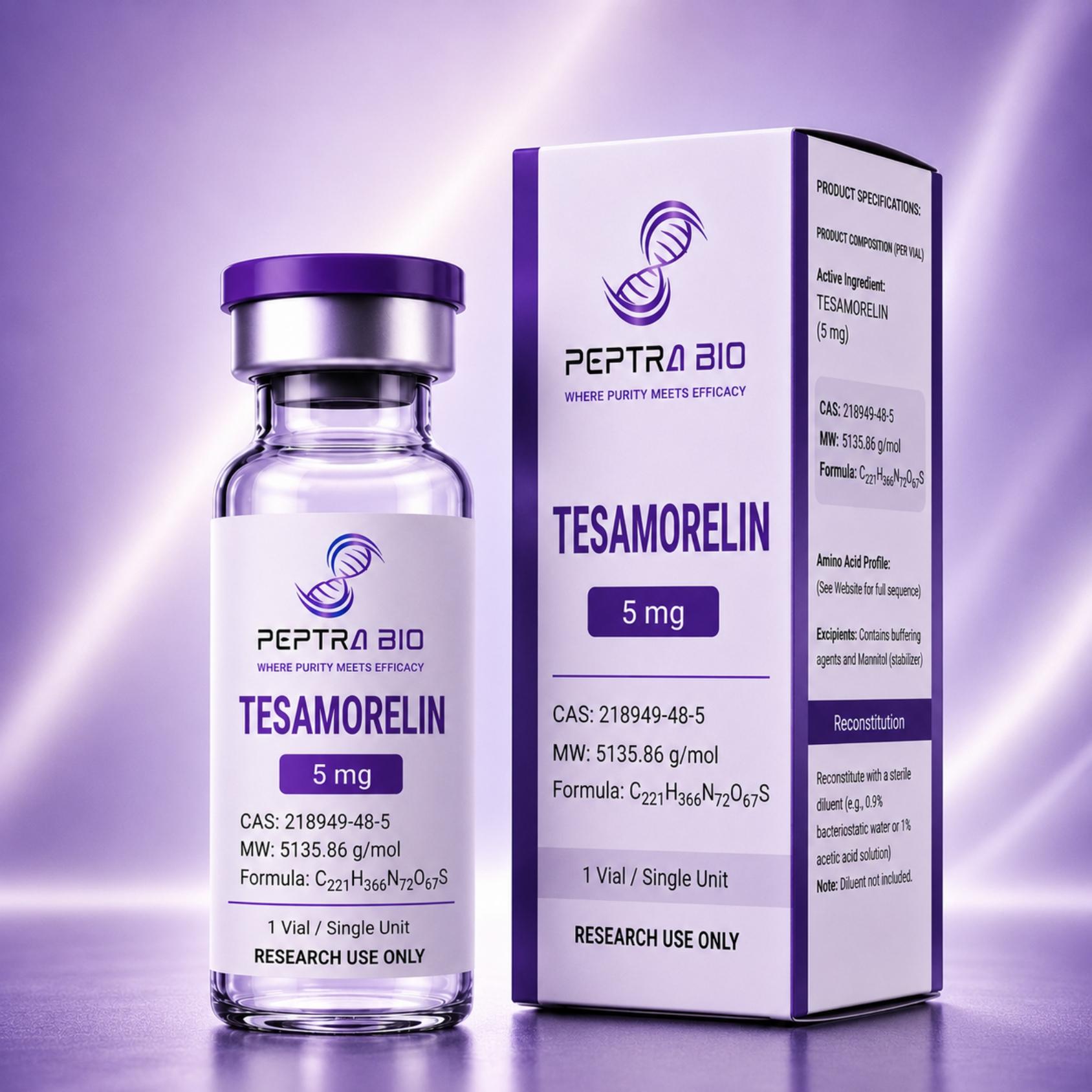
1. Tesamorelin (Stabilized GHRH Analog)
- Structure: A 44-amino acid sequence matching human GHRH, modified by adding a trans-3-hexenoyl group to the N-terminal tyrosine.
- Mechanism: The fatty acid modification protects the N-terminus from DPP-IV enzymatic cleavage, significantly extending biological half-life while retaining full GHRH-R binding potency.
2. Ipamorelin (Selective Pentapeptide GHRP)
- Structure: A synthetic pentapeptide (Aib-His-D-2-Nal-D-Phe-Lys-NH2).
- Mechanism: Acts as a pure, high-affinity agonist at the pituitary GHSR-1a receptor without triggering cortisol or prolactin secretion.
Side-by-Side Receptor & Pathway Comparison
| Parameter | Tesamorelin | Ipamorelin |
|---|---|---|
| Peptide Size | 44 Amino Acids + Hexenoyl | 5 Amino Acids (Pentapeptide) |
| Receptor Target | GHRH-R (Pituitary Somatotrophs) | GHSR-1a (Ghrelin Receptor) |
| Intracellular Second Messenger | Adenylyl Cyclase -> cAMP -> PKA | Phospholipase C -> IP3 -> Ca²⁺ / PKC |
| Primary Research Focus | Visceral Adipose Tissue (VAT), Hepatic Steatosis | Clean Pulsatile GH Release, Bone Density |
| Prolactin & Cortisol Effect | No elevation | No elevation |
| Appetite Impact | Neutral | Neutral / Negligible |
| Regulatory Status | FDA-approved (Egrifta) for HIV lipodystrophy | Investigational Research Compound |
Visceral Adipose Reduction & Metabolic Research

Tesamorelin in Visceral Fat & Liver Fat Assays
In major preclinical and clinical studies, Tesamorelin demonstrated a distinctive ability to reduce visceral adipose tissue (VAT) by 15% to 20% while significantly reducing hepatic fat fraction without depleting subcutaneous adipose layers.
The Synergistic Dual-Pathway Model
In endocrine research protocols, co-stimulating both GHRH-R and GHSR-1a pathways simultaneously overcomes endogenous somatostatin inhibition, producing an amplified growth hormone surge far greater than single-pathway stimulation.
Frequently Asked Questions (FAQ)
What is the primary biochemical difference between Tesamorelin and Ipamorelin?
Tesamorelin acts on the GHRH receptor using a cAMP/PKA cascade, while Ipamorelin acts on the GHSR-1a (ghrelin) receptor using a calcium/IP3 cascade.
Why is Tesamorelin specifically noted for visceral fat research?
Tesamorelin upregulates endogenous GH pulsatility, which selectively enhances lipolysis in metabolically active visceral adipose depots that express high densities of GH receptors.
Do either of these peptides elevate cortisol or prolactin?
No. Unlike older GHRPs (GHRP-6 and GHRP-2), both Tesamorelin and Ipamorelin demonstrate exceptional endocrine selectivity with zero off-target cortisol or prolactin stimulation.
How should lyophilized Tesamorelin be reconstituted?
Reconstitute with bacteriostatic water (0.9% benzyl alcohol) or sterile diluent. Swirl gently without shaking and refrigerate at 2°C–8°C.
Is Ipamorelin approved as a prescription drug?
No. Ipamorelin is an investigational compound intended solely for in vitro and preclinical animal research.
Research Use Only Disclaimer
This pathway guide is prepared solely for scientific education and preclinical research reference. Peptra Bio compounds are intended strictly for laboratory in vitro experimentation.
Key References
- Falutz J, et al. Effects of tesamorelin on visceral fat and metabolic abnormalities in HIV patients. N Engl J Med. 2007;357(17):1703-1713.
- Raun K, et al. Ipamorelin, the first selective growth hormone secretagogue. Eur J Endocrinol. 1998;139(5):552-561.
- Stanley TL, et al. Effects of tesamorelin on hepatic steatosis in non-alcoholic fatty liver disease. Lancet HIV. 2014;1(1):e20-e29.
RELATED RESEARCH GUIDES
View All Articles →BPC-157 vs TB-500: A Comprehensive Research Comparison
Compare the molecular structures, distinct mechanisms of action, and complementary pathways of pentadecapeptide BPC-157 and Thymosin Beta-4 analogue TB-500 in laboratory research.

CJC-1295 (No DAC): Molecular Profile & GHRH Pathway Analysis
Examine the modified tetrasubstituted 29-amino acid GHRH analog CJC-1295 without DAC, its pulsatile release kinetics, and half-life differentiation.

Retatrutide vs Tirzepatide vs Semaglutide: Incretin Mimetic Comparison
A comparative biochemical analysis of mono-agonist (Semaglutide), dual-agonist (Tirzepatide), and triple-agonist (Retatrutide) peptide receptor interactions.