
CJC-1295 (No DAC): Molecular Profile & GHRH Pathway Analysis
Examine the modified tetrasubstituted 29-amino acid GHRH analog CJC-1295 without DAC, its pulsatile release kinetics, and half-life differentiation.

Research Takeaway: CJC-1295 No DAC (Modified GRF 1-29) is a tetrasubstituted 29-amino acid analog of Growth Hormone Releasing Hormone. By eliminating the Drug Affinity Complex (DAC), it preserves short-acting (~30 min) physiological pulsatile GH release without inducing constant receptor saturation.
Executive Overview: The GHRH Axis & Molecular Engineering
Growth Hormone Releasing Hormone (GHRH) is the hypothalamic master regulator of somatotroph cell secretion in the anterior pituitary. Native GHRH 1-29 possesses an extremely brief circulating half-life in mammalian models (< 7 minutes) due to rapid enzymatic cleavage by Dipeptidyl Peptidase IV (DPP-IV).
To circumvent enzymatic degradation while maintaining natural, episodic secretory dynamics, medicinal chemists developed Modified GRF 1-29, widely referenced in research as CJC-1295 No DAC.
Molecular Structure & Tetrasubstitution
CJC-1295 No DAC modifies native GHRH (1-29) at four strategic amino acid positions:
- Position 2: D-Alanine substituted for L-Alanine (protects against DPP-IV enzymatic cleavage)
- Position 8: Glutamine substituted for Asparagine (prevents deamidation)
- Position 15: D-Alanine substituted for Glycine (enhances alpha-helical structural stability)
- Position 27: Leucine substituted for Methionine (prevents oxidative degradation)
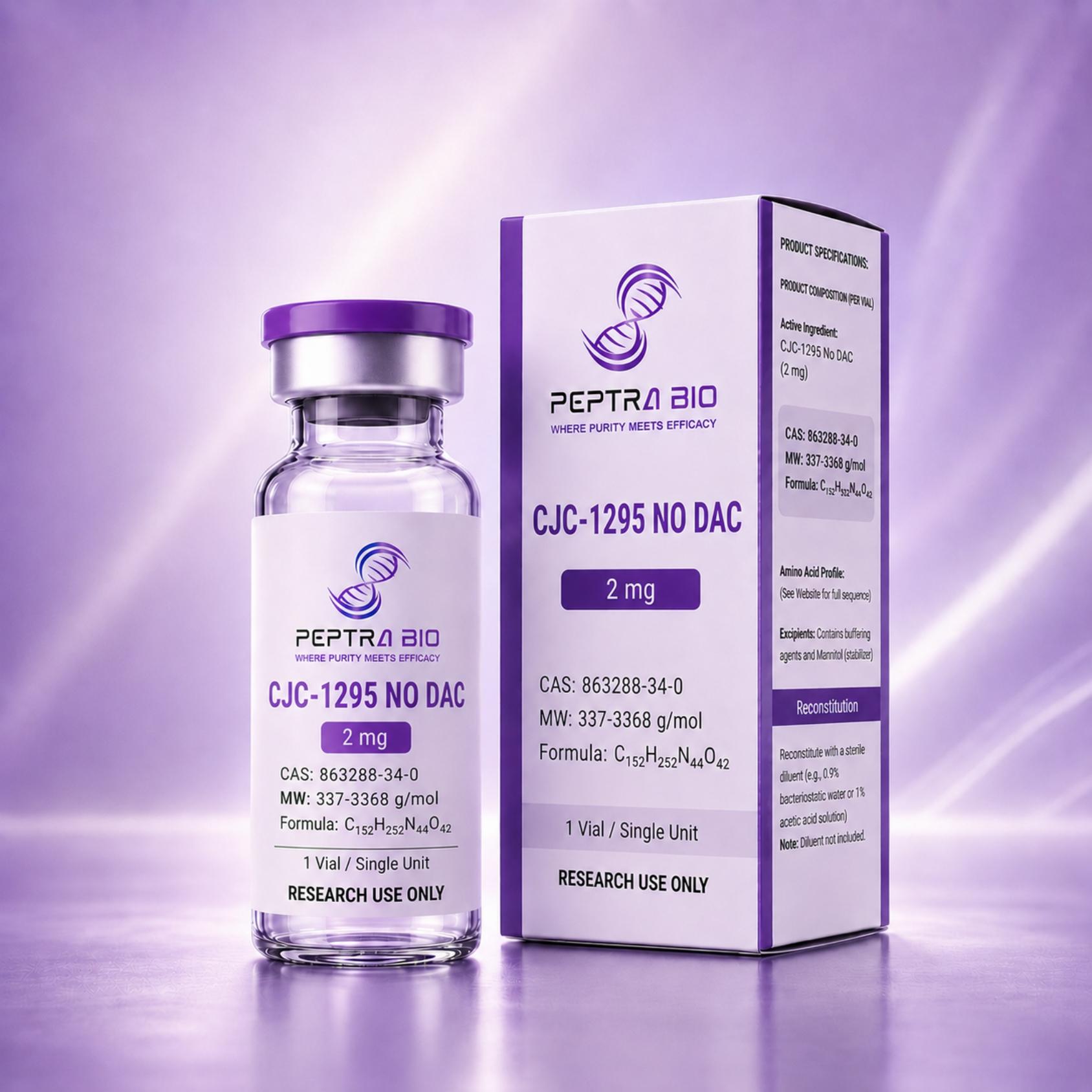
CJC-1295 with DAC vs CJC-1295 No DAC
The presence of the Drug Affinity Complex (DAC) (Maleimidopropionic acid) completely alters pharmacokinetic behavior:
| Molecular Parameter | CJC-1295 (No DAC / Mod GRF 1-29) | CJC-1295 (With DAC) |
|---|---|---|
| Molecular Structure | 29 Amino Acids (Tetrasubstituted) | 29 Amino Acids + Linker + Maleimido Acid |
| Albumin Binding Affinity | Low (Free circulating peptide) | Very High (Covalent conjugation to serum albumin) |
| Biological Half-Life | ~30 minutes | 6 to 8 days |
| Secretory Pattern | Episodic / Pulsatile GH pulses | Continuous, basal elevated GH & IGF-1 |
| Receptor Desensitization Risk | Low (Maintains physiological rhythm) | Moderate (Continuous somatotroph activation) |
| Synergy with GHRPs | Outstanding (Additive pituitary pulse) | Blunted pulse discrimination |
Preclinical Pharmacokinetics & Subcutaneous Dynamics

In rodent and primate endocrine models, subcutaneous delivery of CJC-1295 No DAC exhibits consistent pharmacokinetic parameters:
- Time to Peak Plasma Concentration (Tmax): 15 to 30 minutes post-administration.
- Duration of GH Pulse: 90 to 120 minutes before plasma GH concentrations return to baseline.
- IGF-1 Modulation: Repeated pulsatile administration results in a physiological 1.5x to 2.2x increase in serum IGF-1 without blunting endogenous pituitary response.
Somatostatin Interplay & Synergistic GHRP Co-Administration
Endogenous somatostatin acts as a potent negative feedback inhibitor of GH release. In preclinical protocols:
- CJC-1295 No DAC activates the adenylyl cyclase / cAMP / Protein Kinase A (PKA) pathway.
- Co-administering a Ghrelin Receptor (GHSR-1a) agonist such as Ipamorelin activates the Phospholipase C (PLC) / IP3 / Protein Kinase C (PKC) pathway.
- Simultaneous activation of both second-messenger cascades yields a synergistic GH surge significantly greater than the sum of either peptide alone.
Frequently Asked Questions (FAQ)
Why is CJC-1295 No DAC often referred to as Mod GRF 1-29?
Historically, "CJC-1295" was patented with the DAC (Drug Affinity Complex) technology. The compound synthesized without the DAC component is chemically identical to Modified GRF (1-29). The scientific literature uses Mod GRF 1-29 and CJC-1295 No DAC synonymously.
How does CJC-1295 No DAC resist DPP-IV enzymatic degradation?
The substitution of D-Alanine at position 2 alters the steric conformation of the peptide cleavage site, preventing Dipeptidyl Peptidase IV (DPP-IV) from cleaving the N-terminus.
What is the advantage of a short half-life in GH research?
A ~30-minute half-life allows researchers to simulate natural mammalian pulsatile growth hormone secretion, avoiding the chronic hyper-stimulation and pituitary desensitization associated with long-acting secretagogues.
How should CJC-1295 No DAC be reconstituted and stored?
Reconstitute with bacteriostatic water (0.9% benzyl alcohol). Store lyophilized powder at -20°C and refrigerated liquid solutions at 2°C–8°C away from light.
Is CJC-1295 approved for clinical human treatment?
No. CJC-1295 No DAC is strictly an investigational research chemical intended for in vitro assays and laboratory animal models.
Research Use Only Disclaimer
This document is compiled solely for scientific education and preclinical research reference. Peptra Bio compounds are strictly designated for laboratory research use only.
Key References
- Teichman SL, et al. Prolonged stimulation of growth hormone (GH) and insulin-like growth factor I secretion by CJC-1295. J Clin Endocrinol Metab. 2006;91(3):799-805.
- Ionescu M, Frohman LA. Pulsatile secretion of growth hormone (GH) persists during continuous stimulation by CJC-1295. J Clin Endocrinol Metab. 2006;91(12):4792-4797.
- Alba M, et al. Once-daily administration of CJC-1295 normalizes growth in the GHRH knockout mouse. Am J Physiol Endocrinol Metab. 2006;291(6):E1290-E1294.
RELATED RESEARCH GUIDES
View All Articles →
Ipamorelin 5mg Research Guide: Mechanism, Affinity & Laboratory Profiles
Explore the molecular pharmacology, GHSR-1a selectivity, endocrine stability, and handling protocols of the pentapeptide secretagogue Ipamorelin.
Selank Heptapeptide: Molecular Structure & Receptor Modulation Guide
Examine the regulatory heptapeptide Selank, its tuftsin-derived sequence, allosteric GABA-A modulation, and preclinical neuroprotective properties.

MOTS-c: Mitochondrial-Derived Peptide Signaling & Metabolic Research
Investigate MOTS-c, a 16-amino acid mitochondrial-encoded peptide regulating AMPK pathways, glucose homeostasis, and cellular energy expenditure.