Ipamorelin 5mg Research Guide: Mechanism, Affinity & Laboratory Profiles
Explore the molecular pharmacology, GHSR-1a selectivity, endocrine stability, and handling protocols of the pentapeptide secretagogue Ipamorelin.

Research Takeaway: Ipamorelin is recognized as the most selective synthetic Growth Hormone Secretagogue Receptor (GHSR-1a) agonist. Unlike earlier generation GHRPs, it stimulates robust Growth Hormone secretion without inducing off-target surges in Cortisol, Prolactin, or ACTH.
Executive Overview: Pentapeptide Selectivity & Pharmacology
Ipamorelin (Aib-His-D-2-Nal-D-Phe-Lys-NH2) is a synthetic pentapeptide developed as a third-generation growth hormone secretagogue (GHS). It mimics the biological activity of ghrelin by binding directly to the growth hormone secretagogue receptor 1a (GHSR-1a) in the anterior pituitary gland.
Earlier secretagogues (such as GHRP-6 and GHRP-2) frequently triggered secondary elevations in plasma cortisol and prolactin levels. Ipamorelin was specifically engineered to eliminate these off-target endocrine disruptions.
Chemical Profile & Receptor Dynamics
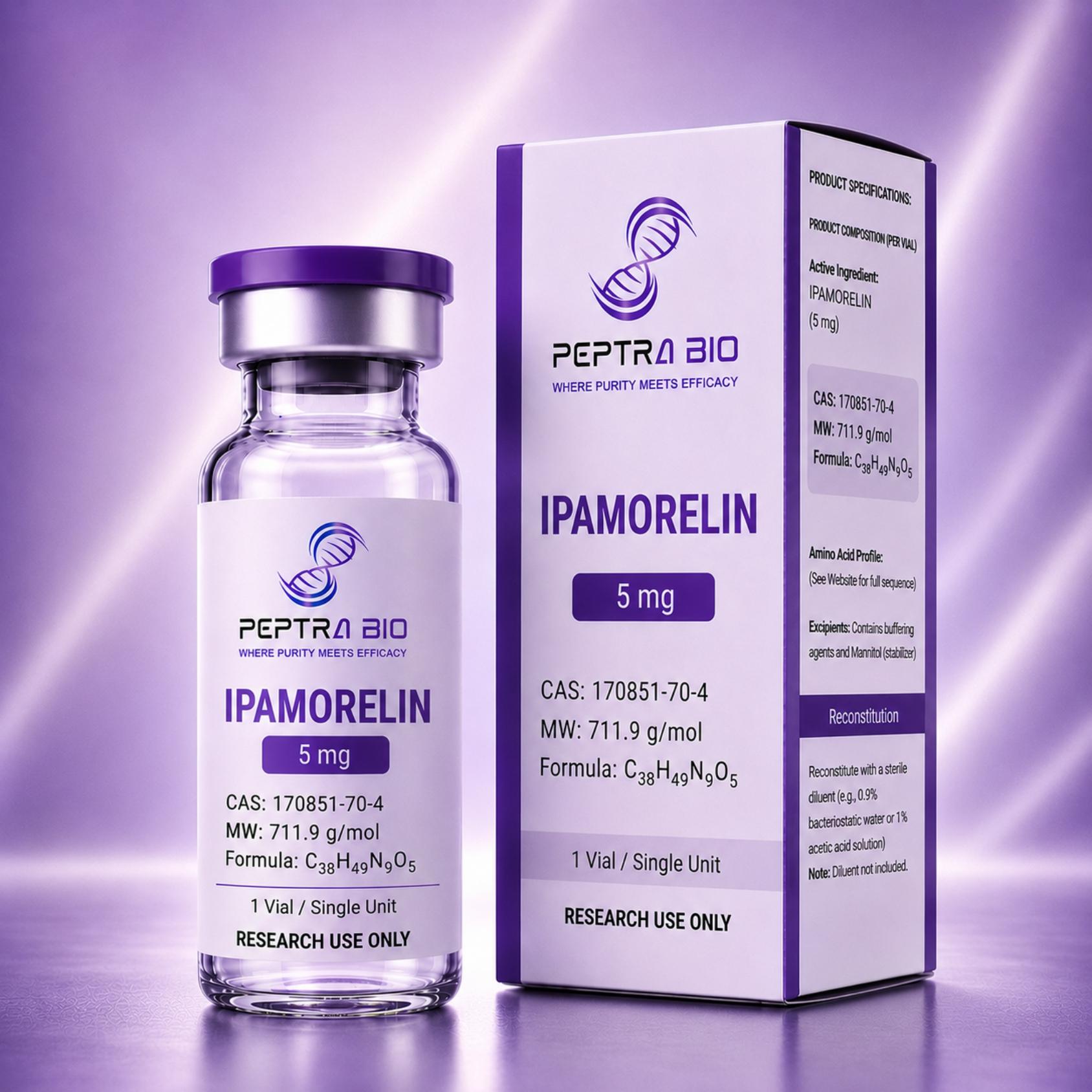
- Molecular Formula: C38H49N9O5
- Molecular Weight: 711.86 g/mol
- Sequence: Aib-His-D-2-Nal-D-Phe-Lys-NH2
- Receptor Affinity: Highly selective for pituitary GHSR-1a; negligible affinity for opioid or central adrenergic receptors.
Intracellular Signaling Cascade
Binding of Ipamorelin to GHSR-1a initiates a downstream G-protein coupled cascade:
- PLC Activation: Phospholipase C is activated, cleaving PIP2 into IP3 (Inositol triphosphate) and DAG (Diacylglycerol).
- Calcium Mobilization: IP3 binds to endoplasmic reticulum receptors, causing a rapid transient influx of intracellular Ca²⁺.
- Pulsatile Exocytosis: Elevated calcium promotes the exocytosis of pre-stored Growth Hormone granules into the extracellular space.
Comparative GHRP Selectivity Matrix
| Secretagogue Compound | GH Release Potency | Cortisol Stimulation | Prolactin Elevation | Appetite Stimulation (NPY) |
|---|---|---|---|---|
| Ipamorelin | High | Undetectable / Baseline | Undetectable / Baseline | Minimal |
| GHRP-6 | High | Mild to Moderate | Mild to Moderate | Very High (Potent hunger trigger) |
| GHRP-2 (Pralmorelin) | Very High | Significant Elevation | Significant Elevation | Moderate |
| Hexarelin | Extremely High | High Elevation | High Elevation | Low (Rapid desensitization) |
Preclinical Research Applications

1. Bone Mineral Density & Osteoblast Proliferation
In rodent models of osteopenia, longitudinal administration of Ipamorelin demonstrated significant increases in bone mineral content and femoral trabecular volume without altering systemic bone remodeling markers abnormally.
2. Gastrointestinal Motility Assays
Because GHSR-1a receptors are expressed across the enteric nervous system, Ipamorelin has been studied in postoperative ileus models, showing accelerated gastric emptying and restoration of bowel motility.
3. Nitrogen Balance & Lean Mass Preservation
In catabolic animal models, Ipamorelin supported positive nitrogen retention and attenuated glucocorticoid-induced muscle wasting.
Reconstitution, Storage & Handling Standards
- Solvent: Bacteriostatic Water (0.9% Benzyl Alcohol) is recommended for standard multi-entry research assays.
- Storage (Lyophilized): Stable at -20°C for up to 24 months.
- Storage (Reconstituted): Maintain between 2°C and 8°C. Solutions should be utilized within 28 days of reconstitution.
Frequently Asked Questions (FAQ)
What makes Ipamorelin different from GHRP-6 and GHRP-2?
Ipamorelin is far more selective. While GHRP-6 and GHRP-2 stimulate cortisol, ACTH, and prolactin alongside growth hormone, Ipamorelin triggers pure GH release without elevating stress hormones.
Does Ipamorelin cause desensitization of the pituitary receptor?
Unlike Hexarelin, which causes rapid tachyphylaxis (receptor down-regulation), Ipamorelin exhibits minimal desensitization during repeated administration cycles in preclinical studies.
Why is Ipamorelin frequently studied in combination with CJC-1295?
Ipamorelin (a GHRP) and CJC-1295 (a GHRH analog) stimulate GH release through distinct intracellular pathways (PLC/Ca²⁺ vs cAMP/PKA). When administered together, they produce a synergistic GH pulse.
What is the typical shelf life of reconstituted Ipamorelin 5mg?
Stored at 2°C–8°C in bacteriostatic water, Ipamorelin remains stable with >95% purity for up to 28 days.
Is Ipamorelin approved for human clinical use?
No. Ipamorelin is an investigational peptide strictly manufactured for in vitro biochemical and animal research use.
Research Use Only Disclaimer
This guide is provided for educational and scientific research purposes only. Peptra Bio supplies peptides strictly for laboratory in vitro experimentation.
Key References
- Raun K, et al. Ipamorelin, the first selective growth hormone secretagogue. Eur J Endocrinol. 1998;139(5):552-561.
- Gobburu JV, et al. Pharmacokinetic-pharmacodynamic modeling of ipamorelin-stimulated growth hormone release in rodents. Pharm Res. 1999;16(9):1412-1416.
- Svensson J, et al. The GH secretagogues ipamorelin and GHRP-6 increase bone mineral content in adult female rats. J Endocrinol. 2000;165(3):569-577.
RELATED RESEARCH GUIDES
View All Articles →
CJC-1295 (No DAC): Molecular Profile & GHRH Pathway Analysis
Examine the modified tetrasubstituted 29-amino acid GHRH analog CJC-1295 without DAC, its pulsatile release kinetics, and half-life differentiation.
Selank Heptapeptide: Molecular Structure & Receptor Modulation Guide
Examine the regulatory heptapeptide Selank, its tuftsin-derived sequence, allosteric GABA-A modulation, and preclinical neuroprotective properties.

MOTS-c: Mitochondrial-Derived Peptide Signaling & Metabolic Research
Investigate MOTS-c, a 16-amino acid mitochondrial-encoded peptide regulating AMPK pathways, glucose homeostasis, and cellular energy expenditure.