How AOD-9604 Works: Lipolytic C-Terminal Domain of Human Growth Hormone
Understand the biochemical mechanisms of the modified hGH fragment 177-191 (AOD-9604) in stimulating adipose beta-3 lipolysis without IGF-1 modulation.

Research Takeaway: AOD-9604 is a synthetic 16-amino acid peptide derived from the C-terminal lipolytic domain of human Growth Hormone (hGH 177-191). By isolating the fat-metabolizing segment from the somatogenic core, it stimulates lipolysis without altering IGF-1 or blood glucose levels.
Executive Overview: Isolating the Lipolytic Domain of Somatotropin
Full-length Human Growth Hormone (hGH) is a 191-amino acid polypeptide that exhibits both anabolic (growth-promoting) and lipolytic (fat-reducing) actions. However, full hGH also induces hyperinsulinemia and elevates systemic IGF-1.
Researchers at Monash University engineered AOD-9604 by isolating the functional C-terminal fragment (residues 177–191) and adding an N-terminal tyrosine residue with a disulfide cyclic bridge to preserve the bioactive conformation.
Molecular Architecture & Chemical Profile
- Sequence: Tyr-Leu-Arg-Ile-Val-Gln-Cys-Arg-Ser-Val-Glu-Gly-Ser-Cys-Gly-Phe (with an internal Cys7–Cys14 disulfide bridge)
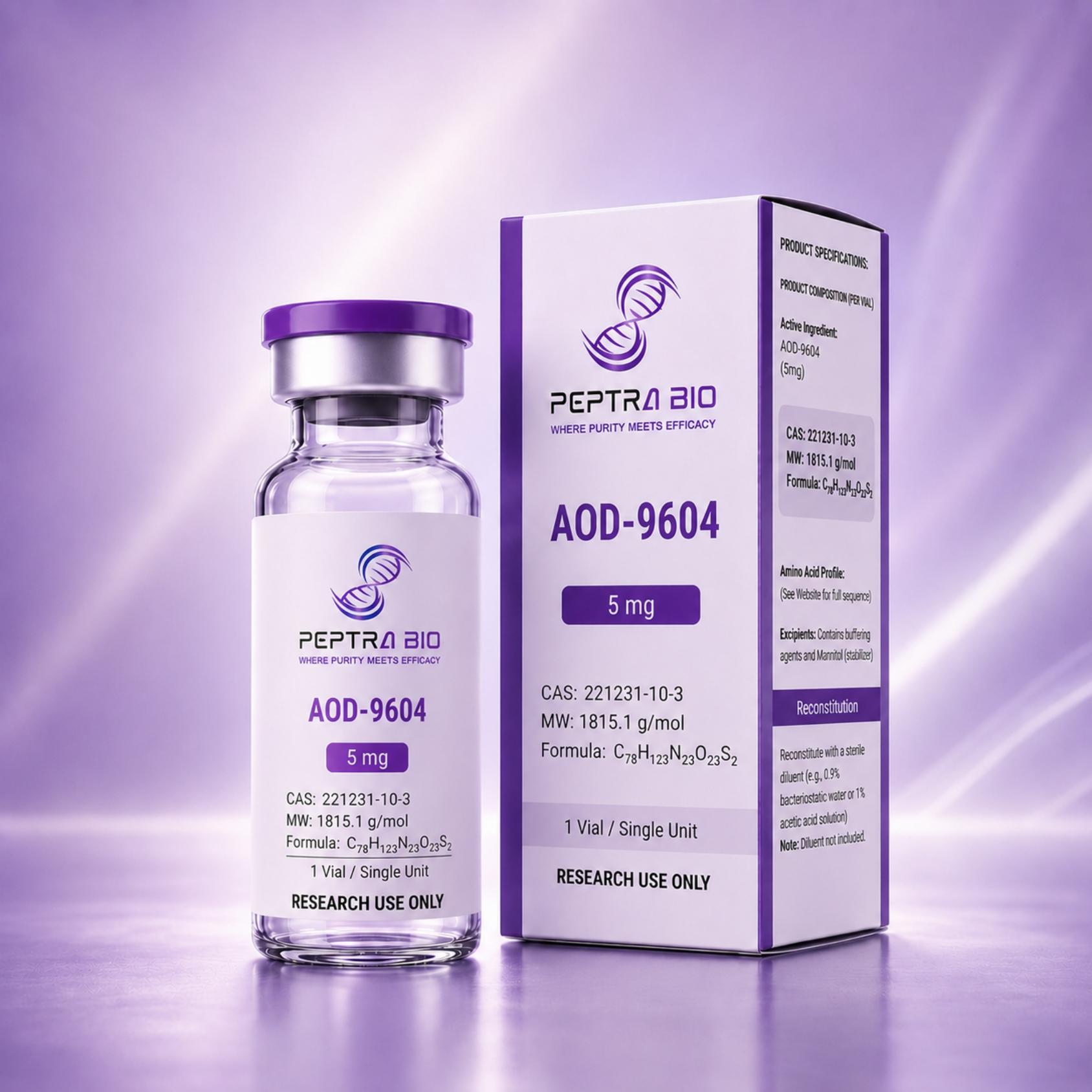
- Molecular Weight: 1815.1 g/mol
- Active Region: Mimics the lipolytic C-terminus of hGH while lacking the N-terminal somatogenic domain responsible for IGF-1 generation.
Dual Mechanism of Action on Adipose Tissue
1. Stimulation of Lipolysis
AOD-9604 upregulates Beta-3 Adrenergic Receptor (β3-AR) signaling on adipocytes, stimulating hormone-sensitive lipase (HSL) to break down stored triglycerides into free fatty acids and glycerol.
2. Inhibition of Lipogenesis
In in vitro fat cell assays, AOD-9604 inhibits the enzymes responsible for converting circulating glucose into fat stores (acetyl-CoA carboxylase and glycerol-3-phosphate dehydrogenase).
Comparison: AOD-9604 vs Full-Length hGH (191 AA)
| Biological Parameter | AOD-9604 (16 AA Fragment) | Full-Length hGH (191 AA) |
|---|---|---|
| Lipolytic Activity | High (Targeted adipose breakdown) | High |
| IGF-1 Generation | None (0% increase) | High (Stimulates hepatic IGF-1) |
| Insulin Resistance Risk | None (Does not impair glucose uptake) | High with repeated exposure |
| Mitogenic Growth Effects | None | High (Cell proliferation across tissues) |
| Molecular Stability | Stabilized by internal disulfide bond | Susceptible to rapid proteolysis |
Preclinical Cartilage & Chondrocyte Research
In addition to adipose studies, recent in vitro and animal models have investigated AOD-9604 in cartilage regeneration:
- When co-administered with hyaluronic acid in rabbit osteoarthritis models, AOD-9604 stimulated chondrocyte proliferation and proteoglycan deposition in articular cartilage defects.
Frequently Asked Questions (FAQ)
Why doesn't AOD-9604 increase IGF-1 or blood sugar?
The IGF-1 stimulating and diabetogenic domains of growth hormone reside in the N-terminal and central regions of the 191-amino acid protein. AOD-9604 contains only the C-terminal 177-191 fragment, completely isolating lipolytic signaling.
What is the role of the disulfide bridge in AOD-9604?
The disulfide bridge between Cysteine-7 and Cysteine-14 maintains the cyclic loop conformation necessary for binding to adipocyte target receptors and protects the peptide from immediate enzymatic degradation.
How is AOD-9604 reconstituted in the lab?
AOD-9604 dissolves well in bacteriostatic water. For highly concentrated solutions, a slightly acidified sterile diluent may assist in rapid dissolution.
What are the storage requirements?
Store dry lyophilized vials at -20°C. Once reconstituted, refrigerate at 2°C–8°C and utilize within 28 days.
Is AOD-9604 approved for clinical human weight loss?
No. AOD-9604 is an investigational peptide strictly manufactured for laboratory and preclinical animal research.
Research Use Only Disclaimer
This technical document is prepared solely for scientific education and laboratory research reference. Peptra Bio supplies compounds strictly for in vitro laboratory experimentation.
Key References
- Ng FM, et al. Metabolic actions of a synthetic C-terminal fragment of human growth hormone (AOD9604). J Mol Endocrinol. 2000;25(3):287-298.
- Heffernan M, et al. The effects of human GH and its lipolytic fragment (AOD9604) on lipid metabolism in obese mice. Endocrinology. 2001;142(12):5182-5189.
- Kwon DR, et al. Effect of intra-articular injection of AOD9604 with hyaluronic acid in a rabbit model of osteoarthritis. Ann Clin Lab Sci. 2015;45(4):426-432.
RELATED RESEARCH GUIDES
View All Articles →CJC-1295 (No DAC): Molecular Profile & GHRH Pathway Analysis
Examine the modified tetrasubstituted 29-amino acid GHRH analog CJC-1295 without DAC, its pulsatile release kinetics, and half-life differentiation.

Retatrutide vs Tirzepatide vs Semaglutide: Incretin Mimetic Comparison
A comparative biochemical analysis of mono-agonist (Semaglutide), dual-agonist (Tirzepatide), and triple-agonist (Retatrutide) peptide receptor interactions.

Ipamorelin 5mg Research Guide: Mechanism, Affinity & Laboratory Profiles
Explore the molecular pharmacology, GHSR-1a selectivity, endocrine stability, and handling protocols of the pentapeptide secretagogue Ipamorelin.