Ipamorelin Explained: A Selective Growth Hormone Secretagogue Profile
A comprehensive technical breakdown of Ipamorelin's molecular structure, receptor selectivity, intracellular signaling, and laboratory research paradigms.

Research Takeaway: Ipamorelin is widely considered the gold standard for selective growth hormone secretagogues. Its pentapeptide design triggers potent, physiological somatotroph exocytosis without inducing the appetite surges or cortisol spikes seen in older GHRP compounds.
Executive Overview: The Evolution of Growth Hormone Secretagogues
Growth Hormone Releasing Peptides (GHRPs) were first discovered in the late 1970s by Bowers and colleagues. Early iterations such as GHRP-6, GHRP-1, and GHRP-2 demonstrated high efficacy in stimulating growth hormone release, but were plagued by off-target side effects:
- Significant increases in plasma Cortisol and Adrenocorticotropic Hormone (ACTH)
- Substantial elevations in Prolactin
- Intense appetite stimulation via central NPY (Neuropeptide Y) activation
To resolve these limitations, researchers engineered Ipamorelin, a third-generation pentapeptide that achieves complete functional selectivity for the GHSR-1a receptor.
Molecular Engineering & Pentapeptide Architecture
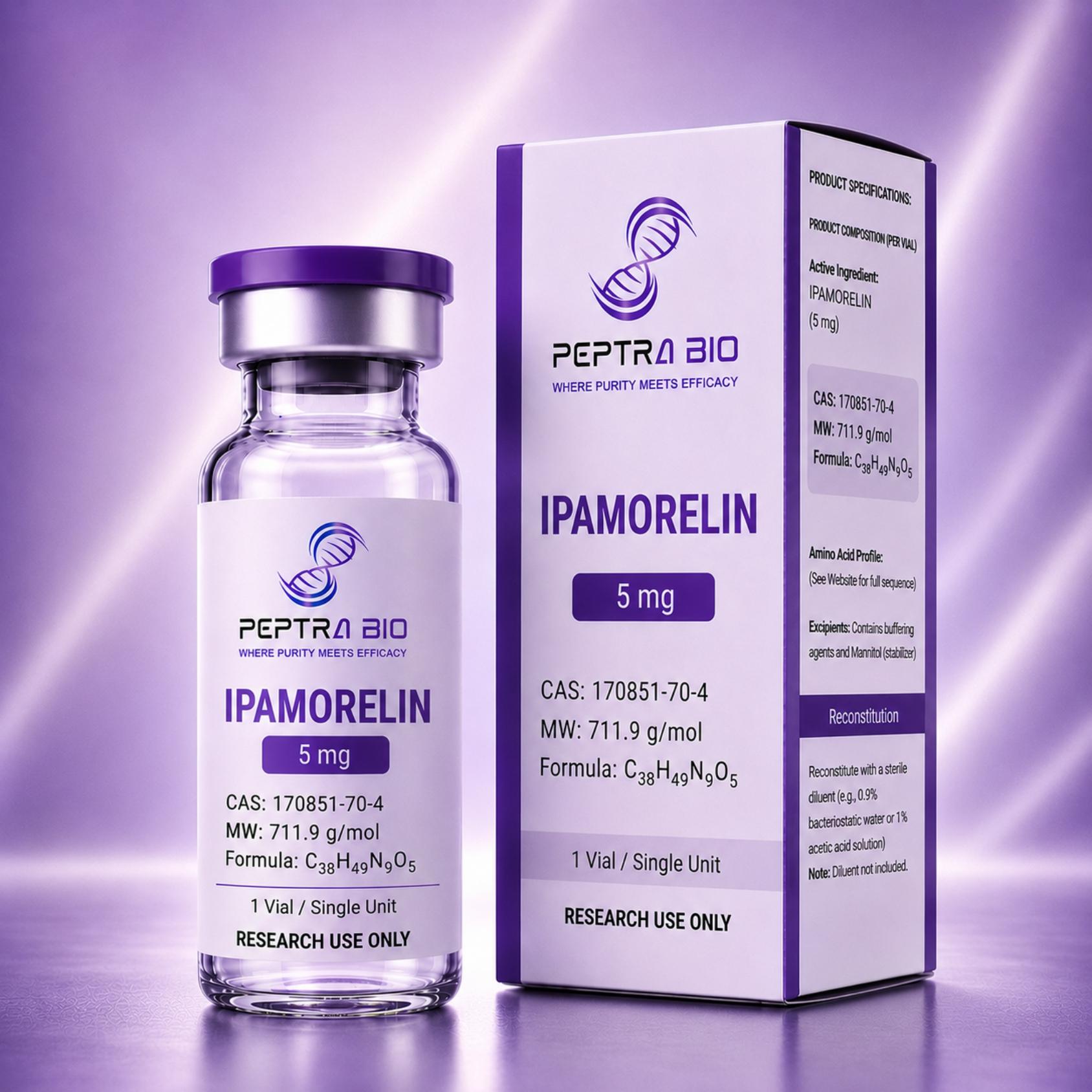
- Amino Acid Count: 5 Residues (Pentapeptide)
- Molecular Formula: C38H49N9O5
- Molecular Mass: 711.86 g/mol
- Key Structural Features: Incorporates Aminoisobutyric acid (Aib) at Position 1 and D-stereoisomers (D-2-Naphthylalanine and D-Phenylalanine) to confer high resistance against proteolytic cleavage by aminopeptidases.
Pituitary Receptor Selectivity Comparison
| Secretagogue Molecule | GH Secretion | Cortisol Surge | ACTH Elevation | Prolactin Elevation | Appetite Induction (NPY) |
|---|---|---|---|---|---|
| Ipamorelin | ++++ | None (0) | None (0) | None (0) | Minimal (0) |
| GHRP-6 | ++++ | ++ | ++ | ++ | ++++ (Intense) |
| GHRP-2 | +++++ | +++ | +++ | +++ | ++ (Moderate) |
| Hexarelin | +++++ | +++ | +++ | +++ | Minimal (0) |
Intracellular Second Messenger Dynamics

- Receptor Ligation: Ipamorelin binds stereospecifically to the transmembrane GHSR-1a receptor on anterior pituitary somatotrophs.
- Gq/11-Protein Coupling: Ligation activates Phospholipase C (PLC).
- Inositol Triphosphate (IP3) Generation: PLC hydrolyzes phosphatidylinositol 4,5-bisphosphate (PIP2) into IP3 and diacylglycerol (DAG).
- Intracellular Ca²⁺ Mobilization: IP3 triggers rapid calcium release from the endoplasmic reticulum, stimulating secretory vesicle fusion and exocytosis of GH into the bloodstream.
Preclinical Laboratory Findings
1. Bone Mineral Accretion & Osteoblast Stimulation
In longitudinal studies of growing and osteopenic animal models, Ipamorelin significantly increased whole-body bone mineral density (BMD) and cortical bone width through GH-mediated osteoblast activation.
2. Maintenance of Lean Tissue in Catabolic States
In rodent models of glucocorticoid-induced muscle atrophy, continuous administration of Ipamorelin maintained positive nitrogen balance, preserved muscle cross-sectional area, and stimulated IGF-1 mRNA expression in muscle tissue.
Reconstitution & Laboratory Handling Protocols
- Reconstitution Solvent: Bacteriostatic Water (0.9% Benzyl Alcohol) is the standard vehicle for multi-dose experimental testing.
- Storage (Lyophilized): Stable at -20°C for up to 24 months.
- Storage (Reconstituted): Maintain between 2°C and 8°C. Protect from direct light. Ensure solution is used within 28 days.
Frequently Asked Questions (FAQ)
What gives Ipamorelin its high receptor selectivity?
The specific sequence conformation (Aib-His-D-2-Nal-D-Phe-Lys-NH2) fits the binding pocket of GHSR-1a precisely, while lacking the electrostatic properties needed to cross-react with hypothalamic CRF or ACTH receptors.
Does Ipamorelin induce tachyphylaxis (rapid tolerance)?
Preclinical studies demonstrate that Ipamorelin does not cause rapid down-regulation of the GHSR-1a receptor, allowing for consistent pulsatile responses across repeated study cycles.
Can Ipamorelin be combined with GHRH analogs in research?
Yes. Ipamorelin is frequently studied alongside CJC-1295 No DAC (Mod GRF 1-29) because they activate separate intracellular pathways (PLC/IP3 vs cAMP/PKA), producing a synergistic GH pulse.
How is the purity of Ipamorelin verified?
Peptra Bio verifies Ipamorelin batches using Reverse-Phase High-Performance Liquid Chromatography (RP-HPLC) and Electrospray Ionization Mass Spectrometry (ESI-MS) to guarantee ≥98% purity.
Is Ipamorelin approved for human therapeutic use?
No. Ipamorelin is an investigational compound manufactured strictly for laboratory in vitro and preclinical research.
Research Use Only Disclaimer
This article is prepared exclusively for scientific education and laboratory research reference. Peptra Bio supplies peptides strictly for in vitro laboratory experimentation.
Key References
- Raun K, et al. Ipamorelin, the first selective growth hormone secretagogue. Eur J Endocrinol. 1998;139(5):552-561.
- Gobburu JV, et al. Pharmacokinetic-pharmacodynamic modeling of ipamorelin-stimulated growth hormone release in rodents. Pharm Res. 1999;16(9):1412-1416.
- Bowers CY. GHRH and GHRP: Basic science and clinical applications. Growth Horm IGF Res. 1998;8(Suppl B):9-14.
RELATED RESEARCH GUIDES
View All Articles →
CJC-1295 (No DAC): Molecular Profile & GHRH Pathway Analysis
Examine the modified tetrasubstituted 29-amino acid GHRH analog CJC-1295 without DAC, its pulsatile release kinetics, and half-life differentiation.
Ipamorelin 5mg Research Guide: Mechanism, Affinity & Laboratory Profiles
Explore the molecular pharmacology, GHSR-1a selectivity, endocrine stability, and handling protocols of the pentapeptide secretagogue Ipamorelin.
Selank Heptapeptide: Molecular Structure & Receptor Modulation Guide
Examine the regulatory heptapeptide Selank, its tuftsin-derived sequence, allosteric GABA-A modulation, and preclinical neuroprotective properties.